

Mixed Numbers
Mixed numbers are a way to express numbers that are made up of a whole number and a fraction. They’re used to represent numbers that fall between whole numbers. For example, if you have more than 1 but less than 2 of something, you can use a mixed number to describe exactly how much you have.
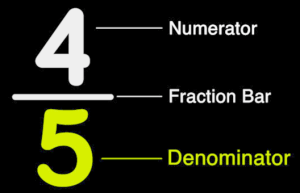
Here’s how a mixed number looks:

- Whole Number: This is the part of the mixed number that is not a fraction. It represents the complete units.
- Numerator: This is the top number of the fraction part of the mixed number. It represents how many parts of a whole you have.
- Denominator: This is the bottom number of the fraction part of the mixed number. It tells you how many parts the whole is divided.
For example, the mixed number 3 1/4 means you have 3 whole units plus 1/4 of another unit.
This could represent something like 3 whole pizzas and one-quarter of another pizza.
Mixed numbers are handy in everyday life, for instance, when measuring ingredients for cooking or marking measurements in construction, because they give a more precise value than just a whole number or a fraction alone.

Fractions
Fractions are a way to represent parts of a whole. Imagine you have a pizza. When it’s not cut, it represents 1 whole or 1/1 (one out of one whole pizza). Now, let’s say you cut the pizza into 4 equal slices.

Each slice of the pizza represents a fraction (quarter) of the whole pizza. If you take one slice equal to 1/4, you will have 3/4 left.

If you take two slices, now you have 2 out of the 4 slices, represented as 2/4, which can be simplified to 1/2 (half of the pizza).
- The denominator (the bottom number of the fraction) tells you how many equal parts the whole is divided. In this case, the pizza is cut into 4 parts, so the denominator is 4.
- The numerator (the top number of the fraction) tells you how many parts of that whole you have. If you have 3 slices, your numerator is 3, representing 3/4 of the whole pizza.

A whole pizza, when cut into 4 slices and if you have all 4 slices, is represented as 4/4, which is equal to 1 whole pizza.
Improper Factions
Let’s explain improper fractions with a scenario involving pizza slices and unexpected guests, which will help clarify how fractions can represent more than a whole.
Imagine you have a whole pizza cut into 4 equal slices, intending to share it equally among 4 people. Each person would get 1/4 of the pizza. Now, imagine two more people show up at your house, wanting a slice each.
For the original 4 guests, you have planned:
| Invited Guess 1 | Invited Guess 2 | Invited Guess 3 | Invited Guess 4 | Unexpected Guess 5 | Unexpected Guess 6 | |
| Slice | 1/4 | 1/4 | 1/4 | 1/4 | 1/4 | 1/4 |
| Total | 1/4 | 2/4 | 3/4 | 4/4 | 5/4 | 6/4 |
In this scenario, the improper fraction 6/4 helps you understand that you have enough pizza to give each of the 6 people a slice (1/4 of a pizza), and it also tells you that you’re dealing with more pizza than just one whole.
Step 1: Divide the Numerator by the Denominator
You divide 6 (the numerator) by 4 (the denominator) to see how many whole units you can get.
6÷4=1 remainder 2
This tells us that 6⁄4 is equal to 1 whole unit plus some part of another unit.
Step 2: Write the Whole Number
The quotient (1 in this case) is the whole number part of the mixed number.
Step 3: Write the Fractional Part
The remainder (2) becomes the numerator of the fractional part, and the denominator remains the same (4 in this case).
So, 6⁄4 can be expressed as 1 2⁄4.
Step 4: Simplify the Fraction (if possible)
The fractional part 2⁄4 can be simplified to 1⁄2 because both the numerator and the denominator can be divided by 2.
Final Result
Thus, the improper fraction 6⁄4 is equal to the mixed number 1 1⁄2.
Inequations

Imagine you and your friends are comparing how many slices of pizza you can eat. Inequations can help us talk about who can eat more or less pizza without specifying the exact number of slices.
- Greater than (>): Think of this as “having more pizza slices.” If I say I can eat more than 3 slices of pizza, it’s like saying, “I can eat 4 slices, 5 slices, or even more!” but not exactly 3 slices. It’s like writing x>3x>3, where xx is the number of slices I can eat.
- Less than (<): This is like “having fewer pizza slices.” If you say you can eat less than 5 slices of pizza, you mean you might eat 4 slices, 3 slices, or even fewer, but not 5 slices or more. We write this as x<5<5.
- Greater than or equal to (≥≥): Imagine the pizza monster turns up at your house, and it can eat at least 4 slices of pizza, maybe even more. That’s saying you can eat 4 slices, 5 slices, or more. It’s like having at least a certain amount of pizza. We say x≥≥4.
- Less than or equal to (≤≤): This is if you’re not very hungry and say, “I can eat 4 slices of pizza or fewer.” Maybe you’ll eat 3 slices, or maybe even just 1 slice, but not more than 4. It’s like putting a cap on the maximum pizza slices. We say x≤≤4.
Inequations, also known as inequalities, are mathematical expressions that show the relationship between two values where they are not equal. Inequations use symbols to indicate that one value is greater than, less than, greater than or equal to, or less than or equal to another value.
 Jamie Clague